You plug a battery into your charger and nothing happens. No lights, no charge indicator. The charger doesn’t recognize it.
This commonly happens when batteries are stored too long, left in unused devices, or exposed to heat. The battery isn’t necessarily dead, it’s deeply discharged below the voltage threshold most chargers require to start charging. This is where 0V activation becomes useful. A 0V lithium battery charger can detect and safely revive these over-discharged cells.
What Is 0V Charging?
0V charging (also called 0V Activation) is a smart charging function that detects and safely revives lithium-ion batteries that have dropped below the minimum voltage threshold recognised by standard chargers.
When a rechargeable lithium battery is deeply discharged through prolonged storage, accidental full drain, or being left in a forgotten device for months, its protection circuit kicks in and shuts the cell down. From the outside, it looks dead. Most chargers will see the near-zero voltage and refuse to engage.
A charger with 0V Activation handles this differently. Instead of ignoring the battery, it applies a small, carefully controlled pulse of current to probe and then gradually revive the cell, waking it from its dormant state without stressing it.
Why Is My Lithium Battery Showing 0V?
If your lithium battery reads 0V (or near 0V) on a charger or multimeter, one of two things has happened:
- Deep discharge with protection circuit activated — The cell’s built-in protection circuit has shut it down to prevent further damage. The battery may still be recoverable. This is the most common cause.
- Irreversible internal damage — After extreme discharge, physical damage, or very long storage at 0V, the cell’s chemistry has broken down permanently. This battery cannot be recovered.
The only way to tell the difference is to attempt 0V Activation with a compatible 0V lithium battery charger. If the battery responds within 15–30 minutes, it was in the first category. If it doesn’t, it’s genuinely at end-of-life.
How 0V Activation Works
The Three-Stage Process
1. Detection
The charger sends a low-current probe to read the battery’s state. Intelligent circuitry distinguishes between a dormant but recoverable cell and one that has failed — preventing wasted charge attempts and flagging genuine damage.
2. Gentle Activation
If the battery is viable, the charger applies a minimal charging current — far below normal charging rates. This controlled approach avoids the cell stress that a sudden high-current charge would cause, which can permanently reduce capacity or create safety hazards.
3. Transition to Normal Charging
Once the cell voltage climbs above the safe threshold, the charger transitions automatically into standard CC/CV (constant current / constant voltage) mode and completes the charge at optimal parameters.
Why the Controlled Current Matters
Forcing a deeply discharged lithium battery with full charging current can cause:
- Internal cell damage and permanent capacity loss
- Overheating
- Shortened lifespan
- In severe cases, safety risks
The slow, graduated approach of 0V Activation avoids all of this.
How Do You Get a Lithium Battery Out of Sleep Mode?
Lithium battery protection circuits are sometimes described as putting the cell into “sleep mode” and the analogy is accurate. The battery isn’t dead; it’s unresponsive and waiting.
Getting a lithium battery out of sleep mode requires a charger that can deliver a gentle pre-charge pulse below the normal voltage recognition threshold. Standard chargers simply don’t do this, they check for a minimum voltage, find nothing, and stop.
Modern intelligent chargers now include this 0V charging function as a standard feature for anyone using high-drain 18650 batteries or other rechargeable lithium-ion cells.
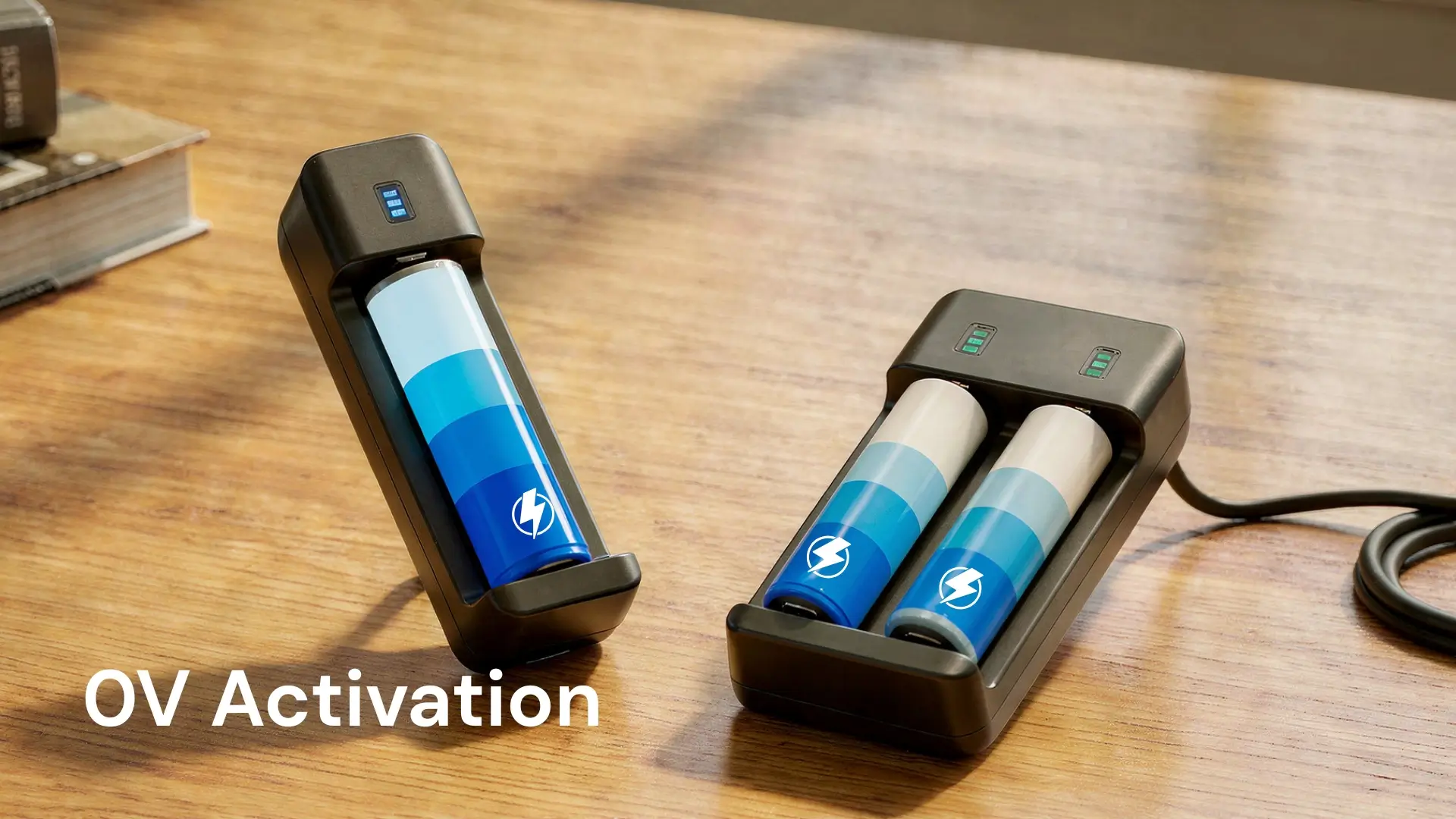
The 0V Activation function in the Uniross Neo1 and Neo2 chargers is specifically engineered for this purpose. When you insert a battery in sleep mode, the charger detects the low-voltage state and automatically initiates the activation sequence without any manual input required. It provides a reliable 0V charging function that ensures your expensive cells don’t end up discarded prematurely.
For businesses managing large battery inventories — from photography equipment to industrial tools. Having chargers with 0V activation capability can significantly reduce operational costs by recovering cells that would otherwise be replaced. Contact us to discuss bulk charger solutions or book a technical consultation.
When Do Batteries Become Over-Discharged?
Over-discharged batteries are common in real-world use:
- Forgotten devices — A camera, torch, or portable speaker left unplugged and unused for months, particularly in high-drain applications like USB-C rechargeable devices
- Extended storage without top-ups — Lithium cells gradually self-discharge; left long enough, they drop below the protection threshold
- Accidental complete drain — A device used until empty, then not recharged for weeks or longer
- Batteries in transit or storage — Cells shipped or warehoused in discharged devices
The key variable is time. A battery that became deeply discharged last week has a much better recovery rate than one that has sat at near-zero voltage for six months.
Benefits of 0V Activation
Recover Batteries That Would Otherwise Be Discarded
Cells that appear completely dead can often be brought back to usable condition — saving you the cost of replacement and the waste of disposal.
Extend the Useful Life of Every Battery
Rather than writing off a battery the first time it drops into deep discharge, 0V Activation gives it a second chance. Over a collection of batteries, this adds up.
No Manual Intervention
The process is automatic. Insert the battery, and the charger handles detection, activation, and transition to normal charging on its own.
Reduce Electronic Waste
Recovered batteries stay in use rather than going to recycling prematurely. Fewer batteries discarded means less e-waste.
Confidence in the Field
For photographers, outdoor users, and anyone managing multiple battery sets, knowing your charger can handle a deeply discharged cell removes one potential point of failure.
Does 0V Activation Work on LiFePO4 Batteries?
LiFePO4 (lithium iron phosphate) batteries are not the same as standard Li-ion. They have a different nominal voltage (3.2V vs. 3.7V), a different discharge curve, and different protection thresholds. Understanding these differences is crucial you can learn more in our Complete Types of Batteries Guide.
The Uniross Neo1 and Neo2 are designed for 3.7V Li-ion and INR cylindrical cells. Using them on LiFePO4 cells is not recommended, as the voltage profiles are incompatible.
What Are Common LiFePO4 Charging Mistakes?
When working with LiFePO4 cells, users often make these critical errors:
- Using a standard Li-ion charger — The most common mistake. LiFePO4 cells charge to 3.6V maximum, not 4.2V like standard Li-ion. Using the wrong charger can overcharge and damage the cells.
- Assuming 0V Activation works identically — LiFePO4 protection circuits have different cutoff thresholds and wake-up requirements compared to Li-ion cells.
- Not verifying battery chemistry before charging — Always confirm whether your cylindrical cell is Li-ion (3.7V) or LiFePO4 (3.2V) before selecting a charger.
- Mixing LiFePO4 and Li-ion in the same device — This can cause uneven discharge rates and potential damage to the LiFePO4 cells.
For LiFePO4 cells, always use a charger explicitly designed for that chemistry. The Uniross Neo series is optimized exclusively for 3.7V Li-ion and IMR formats.
Uniross Neo Series: Built-In 0V Activation
Both the Uniross Neo1 (single-slot) and Neo2 (dual-slot) chargers include 0V Activation as a core feature and not as an add-on.
Key Features
| Feature | Benefit |
|---|---|
| 0V Activation | Automatically detects and revives deeply discharged batteries |
| CC/CV Charging | Switches between constant current and constant voltage for optimal charge quality |
| Overcharge Protection | Cuts off charge at full capacity to protect battery health |
| Reverse-Polarity Protection | Prevents damage from incorrect battery insertion |
| Universal USB-C Input | Charges from any USB-C source (5V/1A) — laptop, power bank, wall adapter |
| Compact and Portable | Lightweight design suited to travel, photography, and everyday carry |
Compatible Battery Formats
Both models support the most widely used cylindrical Li-ion and IMR formats:
18650 (the most common format — used in cameras, torches, and power tools), 18500, 18350, 16340, 14500, 10440, and more.
Neo1 vs. Neo2
| Neo1 | Neo2 | |
|---|---|---|
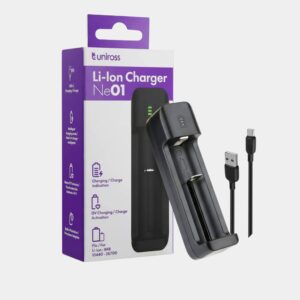 | 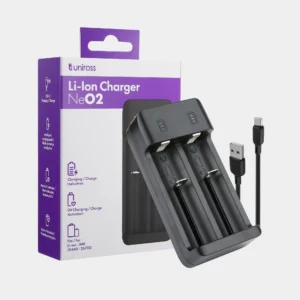 | |
| Slots | 1 | 2 |
| Best for | Flashlights, Single-battery use, photographers, everyday carry | Flashlights, Multiple battery sets, dual charging, power users |
| Size | Ultra-compact | Compact dual-channel |
| Technical Datasheet | View Neo1 technical specifications | View Neo2 technical specifications |
For Business & High-Volume Applications
The Neo series chargers are designed for both individual users and business environments:
- Retail & Distribution: Stock chargers with proven 0V recovery capability to reduce customer battery returns
- Photography Studios: Recover expensive 18650 cells used in flash equipment and camera gear
- Industrial Applications: Maintain battery fleets for tools, measurement devices, and portable equipment
- Electronics Repair: Revive customer batteries that appear dead before recommending replacement
- Professional Lighting Equipment: Ideal for maintaining batteries used in high-performance torches and tactical lighting from brands including Maglite, Ledlenser, Nitecore, Petzl, Streamlight, SureFire, Fenix, Klarus, Nextorch, Imalent, Wuben, Acebeam, Armytek, MF Optoelectronics, Walther (Umarex), Ditac, Coast, Olight, Lumintop, and Convoy
Popular Professional Torches with Removable Rechargeable Batteries
Many professional-grade torches use removable 18650 or 21700 Li-ion batteries that the Neo series chargers can maintain and revive:
| Brand | Model | Battery Type | Removable |
|---|---|---|---|
| Fenix | PD36R Pro | 21700 | Yes |
| Nitecore | MH12S | 21700 | Yes |
| Nitecore | P20iX | 21700 | Yes |
| Nitecore | SRT7i | 21700 / CR123A | Yes |
| Klarus | XT21X Pro | 21700 / 18650 | Yes |
| Streamlight | ProTac HL-X | 18650 | Yes |
| Acebeam | E70 Mini | 18650 | Yes |
| Acebeam | L35 V2.0 | 21700 | Yes |
| Armytek | Wizard C2 Pro | 18650 | Yes |
| ThruNite | TC15 V3 | 18650 | Yes |
The Neo series is the perfect replacement for standard manufacturer chargers. While many professional torches include basic charging solutions, the Neo1 and Neo2 offer significant advantages: intelligent 0V activation to recover deeply discharged cells, overcharge protection to extend battery lifespan, reverse-polarity protection for safety, and universal USB-C compatibility for charging anywhere. Unlike basic chargers that simply reject dead batteries, the Neo series actively recovers them, turning potential waste into usable runtime.
For professionals managing battery inventories across multiple torch units; whether in security, search and rescue, law enforcement, or outdoor recreation. The Neo series provides a reliable charging and recovery solution that extends battery life and reduces replacement costs.
Interested in bulk orders or custom OEM solutions?
Request a quote or schedule a consultation with our technical team to discuss your specific requirements.
Important Limitations
0V Activation is powerful but not guaranteed. Some batteries are genuinely beyond recovery.
Batteries That Cannot Be Revived
- Cells left at near-zero voltage for many months or years
- Batteries with internal short circuits
- Physically damaged or swollen cells
- Very old batteries with high cycle counts and degraded chemistry
These have undergone irreversible chemical changes. 0V Activation will not recover them.
How to Tell When to Stop
If a battery does not respond within 30 minutes of activation there is no voltage rise, no transition to normal charging, or an error indicator, it has reached end-of-life. Recycle it rather than continuing to attempt recovery.
What Improves Recovery Odds
- Short time in deep discharge — days or weeks, not months
- Good storage conditions — cool and dry
- Battery age — newer cells recover better than aged ones
- Original quality — higher-quality cells are more resilient
Best Practices to Avoid Deep Discharge
The best use of 0V Activation is as a safety net, not a routine. To minimize how often you need it:
- Store at partial charge — 30–80% is the ideal storage state for Li-ion cells
- Top up every few months — if batteries will sit unused for extended periods
- Use regularly — batteries that cycle regularly stay healthier than those left idle
- Store in cool, dry conditions — heat accelerates self-discharge
- Use an intelligent charger — one that monitors voltage and stops at full capacity, like the Neo series
For more detailed guidance on battery care, see our Essential Guide to Maintaining Rechargeable Batteries.
Frequently Asked Questions
What is 0V charging?
0V charging is a charger function that applies a low, controlled pre-charge current to lithium-ion batteries that have dropped below the voltage threshold standard chargers require to start. It revives batteries from a deeply discharged or dormant state. Also referred to as 0V Activation or the 0V charging function.
Why is my lithium battery showing 0V?
Most likely, the battery’s internal protection circuit has shut it down after deep discharge — this is a safety feature, not permanent damage. A charger with 0V Activation can often revive it. If it doesn’t respond within 30 minutes of activation, the battery has likely failed internally and should be recycled.
How do you get a lithium battery out of sleep mode?
Use a charger with a dedicated 0V Activation or pre-charge function. The charger will apply a gentle low-voltage current to wake the cell from its dormant protection state. The Uniross Neo1 and Neo2 do this automatically — just insert the battery and the charger handles the rest.
Will 0V Activation damage my battery?
No. The controlled, low-current approach is gentler than normal charging, not more aggressive. It’s specifically designed to minimise stress on cells in a vulnerable state.
How long does 0V Activation take?
Initial activation typically takes 5–15 minutes before the battery voltage rises enough for normal charging to begin. Total charge time after that depends on the cell’s capacity.
Does 0V Activation work on LiFePO4 batteries?
The Uniross Neo1 and Neo2 are designed for 3.7V Li-ion and IMR cylindrical cells. LiFePO4 cells have a different nominal voltage (3.2V) and require a charger designed specifically for that chemistry. Using a Li-ion charger on LiFePO4 is one of the most common LiFePO4 charging mistakes — avoid it.
Can I use 0V Activation on a 12V battery?
No. 0V Activation in this context is designed specifically for 3.6–3.7V cylindrical lithium cells (like 18650, 14500, 16340, etc.).
12V batteries fall into two categories, neither compatible with cylindrical Li-ion chargers:
- 12V lead-acid batteries (car batteries, sealed lead-acid) — Use entirely different chemistry and require dedicated lead-acid desulphation chargers
- 12V lithium battery packs (3S configuration) — Require specialized BMS-compatible chargers with balancing functions
Attempting to use a single-cell Li-ion charger on 12V batteries will not work and could be dangerous. Always match your charger to your battery’s voltage and chemistry specifications.
What’s the difference between an over-discharged battery and a dead one?
An over-discharged battery has entered a dormant protection state but its chemistry may still be intact. A dead battery has suffered irreversible internal damage. 0V Activation attempts to distinguish between the two — if the battery responds, it was dormant; if not, it was genuinely at end-of-life.
How often can I use 0V Activation on the same battery?
Occasionally is fine. Repeatedly allowing a lithium battery to reach deep discharge and then reviving it does accelerate degradation over time, so good charging habits remain the better long-term approach.