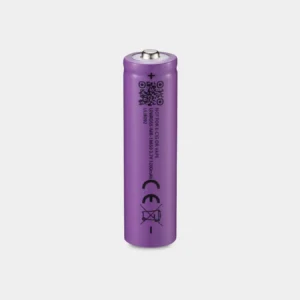
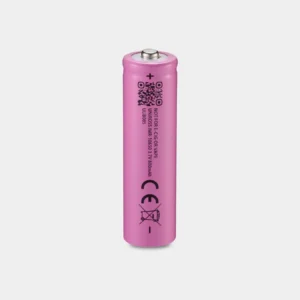
Industrial-grade rechargeable 18650 cylindrical lithium cells built on IMR chemistry for high-drain, safety-critical, and thermally demanding applications.
Uniross IMR18650 cylindrical cells deliver 3.7V nominal output in the industry-standard 18650 format using lithium manganese oxide (IMR) chemistry — a chemistry selected for its superior thermal stability, lower internal resistance, and high continuous discharge capability relative to conventional ICR (cobalt-based) lithium-ion cells. Where ICR cells prioritise energy density, IMR cells prioritise safe high-current delivery and thermal resilience, making them the preferred specification for industrial battery pack assemblies, power tools, portable instrumentation, and safety-critical devices where cell-level thermal runaway risk must be minimised.
Why IMR Chemistry for Industrial Applications
Standard ICR (LiCoO₂) lithium-ion cells deliver high energy density but carry elevated thermal risk under abuse conditions — over-discharge, high rate discharge, and elevated temperature operation all increase the probability of thermal runaway in cobalt-based chemistries.
IMR (LiMn₂O₄) chemistry addresses this directly:
Lower thermal runaway risk — manganese oxide cathode chemistry is structurally more stable than cobalt oxide under thermal stress; IMR cells exhibit lower peak temperatures in abuse scenarios and are less susceptible to self-sustaining exothermic reactions.
Lower internal impedance — IMR cells sustain higher continuous and pulse discharge currents with lower voltage sag than equivalent-capacity ICR cells; critical for motor-driven tools, high-drain RF modules, and multi-sensor acquisition systems.
Stable discharge voltage — flat discharge curve from full charge to cut-off; voltage-sensitive electronics see consistent supply throughout the discharge cycle.
Standard 4.2V charge ceiling — fully compatible with standard CC/CV lithium-ion charging circuits; no custom BMS chemistry configuration required.