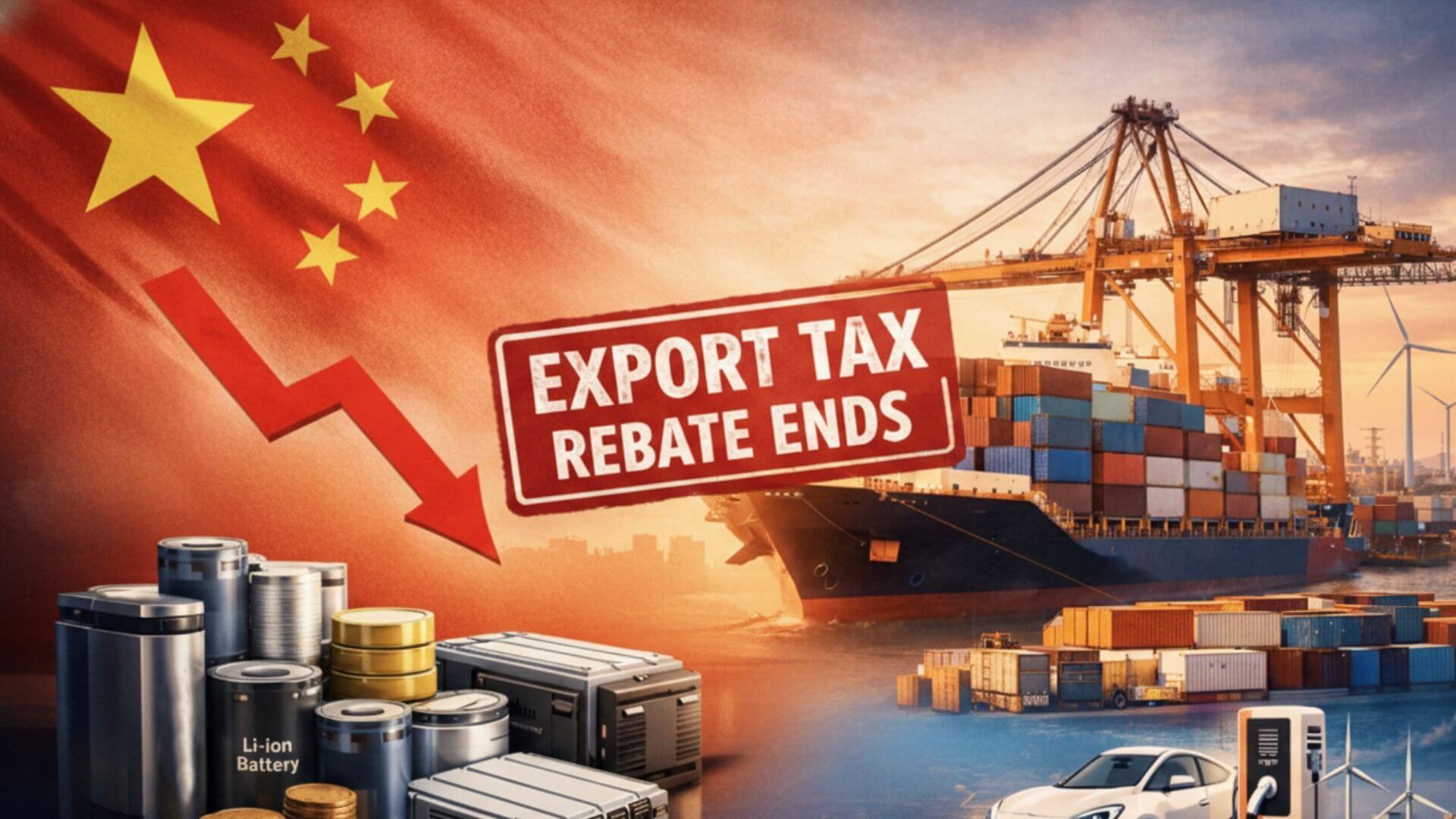
China’s government has unveiled a major policy shift that will phase out export tax rebates for battery products over the next two years. This move is poised to raise Chinese exporters’ costs and reshape global pricing dynamics for batteries, affecting energy storage, electric vehicles (EVs), and electronics supply chains worldwide. Announced in a joint statement by China’s Ministry of Finance and State Taxation Administration in January 2026, the policy will be implemented in stages and marks a significant change in China’s export strategy. Below we break down the key changes, the rationale behind this decision, and what it means for battery industry stakeholders, including manufacturers, OEMs, and B2B distributors.
Quick Summary
- Back in 2025, China had reduced battery export VAT rebates from 12% to 9%.
- China will reduce battery export VAT rebates from 9% to 6% in 2026 and remove them entirely in 2027.
- Global battery prices are likely to rise as rebates are phased out.
- B2B buyers may need to adjust supply chain planning and procurement strategies.
- The policy encourages a shift toward higher-value battery technologies and more sustainable competition.
- Energy storage, EV, and electronics sectors could see changes in project economics and timelines.
- The move may reduce trade tensions and create a more stable, market-driven pricing environment.
Key Policy Changes
Phased Rebate Reduction (2026): From April 1, 2026 through December 31, 2026, the value-added tax (VAT) export rebate on Chinese battery products will be reduced from 9% to 6%. In other words, exporters will recoup a smaller percentage of VAT on battery exports during this interim period, effectively raising their cost on each unit sold abroad. (For context, a similar policy for photovoltaic (solar) products will take effect even sooner: VAT export rebates for solar panels and related goods will drop to 0% starting April 2026.)
Full Rebate Elimination (2027): On January 1, 2027, China will completely abolish the VAT export rebate for battery products. From that date onward, battery exporters will no longer receive any VAT refund for exports, marking the end of a longstanding export incentive. This aligns with China’s removal of rebates for other sectors (such as the immediate April 2026 removal for solar/PV goods) and reflects a broad policy of withdrawing tax-based export support.
Context and Rationale Behind the Policy
China is the world’s dominant supplier of batteries – ranging from lithium-ion cells for EVs and electronics to large-format batteries for energy storage. Historically, Chinese exporters benefited from government VAT rebates on exports, which effectively subsidized their overseas sales. These rebates allowed companies to offer lower prices to foreign buyers, sometimes using the rebate margin as a “price discount” tool in global markets. While this boosted export competitiveness, it also led to market distortions: ultra-low pricing, razor-thin margins, and growing trade friction with other economies.
Several factors explain why China is pulling back these incentives now:
- Intensifying Competition & Price Wars: In recent years, global competition in batteries (and solar products) has intensified, and export prices have been on a downward slide. Chinese industry bodies acknowledge that generous rebates fueled excessive price cutting, exporters were undercutting each other to gain market share abroad, using the rebate to sustain below-normal prices. This led to deflationary price wars that eroded profits and was deemed unsustainable. By reducing and removing rebates, authorities aim to put a floor under prices and curb the aggressive pricing supported by subsidies.
- Trade Tensions and Anti-Dumping Concerns: The policy is also seen as a move to ease international trade disputes. Heavily subsidized exports from China have raised concerns in Europe and elsewhere about unfair competition (e.g. dumping). Chinese officials and analysts indicate that rolling back export rebates is partly to “promote a rational return of foreign market prices and reduce the risk of trade frictions.” In other words, China is signaling to its trade partners, especially the EU, which has scrutinized Chinese battery and EV pricing, that it is willing to let export prices rise to more market-driven levels. This goodwill gesture could alleviate pressure for tariffs or other retaliatory measures.
- Domestic Overcapacity & Industrial Upgrading: This change aligns with China’s broader industrial policy goals. The battery and solar industries have experienced periods of overcapacity and “irrational” expansion, leading to fierce internal competition (“involution-style” price wars) that Beijing wants to curb. By removing rebates, the government is nudging the industry away from volume-at-all-costs. It encourages Chinese firms to consolidate and focus on efficiency and innovation rather than relying on tax perks. Notably, China had already taken a step in this direction at the end of 2024 by cutting export rebate rates from 13% to 9% for batteries and solar products. The current policy is a decisive escalation of that strategy, aimed at long-term sector health.
Expected Impacts on Exporters and Global Markets
The phased rebate removal will have significant short-term and long-term impacts on battery exporters and international buyers:
- Higher Export Costs: Removing the VAT rebate raises the cost when selling abroad. Analysts estimate this policy will “materially increase export costs” for China’s battery makers. In practical terms, during April–Dec 2026 exporters will lose 3% of extra margin (receiving a 6% rebate instead of 9%), and from 2027 onwards they lose the entire 9%. These added costs will squeeze exporter margins unless they adjust prices upward.
- Likely Price Increases in Global Markets: As the rebate cushion disappears, international prices for battery products are expected to rise relative to today’s levels. Industry observers anticipate that this policy will put upward pressure on battery prices in 2026–2027, especially for sectors heavily reliant on Chinese imports (such as lithium-ion cells for EVs, consumer electronics batteries, and large battery packs for energy storage). The era of steeply falling battery prices may slow as China’s export incentives are withdrawn, potentially affecting cost projections for electric vehicles and renewable energy storage projects in the coming years.
- Surge in Shipments Before the Deadline: In the immediate term, the policy timing could trigger a front-loading of exports. With the rebate cut looming in April 2026, we will rush shipments in Q1 2026 to still capture the full 9% rebate. This could lead to a temporary export boom or “export spike” in early 2026 as companies fulfill overseas orders early. For example, raw material markets have already reacted: Lithium prices spiked when the policy was announced, as investors bet on a short-term jump in battery production and exports before the rebate reduction. Importers and distributors might stock up on inventory ahead of the April 1 change to take advantage of current prices.
Why This Policy Matters to the Battery Industry?
This development in China is more than an isolated tax change, it is a bellwether for global battery markets. For companies in the B2B battery space (like battery distributors, OEMs, and large-scale battery users), the effects will be tangible:
- Global Battery Pricing Trends: All eyes will be on pricing in 2026–2027.
- Procurement and Inventory Strategies: Battery buyers may need to time their purchases strategically. Some distributors and OEMs might choose to advance their orders before April 2026 to still enjoy the lower prices while the 9% rebate is in effect.
- Geopolitical and Trade Considerations: China’s rebate removal can also be seen in light of global trade politics. It may reduce the likelihood of punitive tariffs on Chinese batteries in Western markets, which is positive for global supply stability.